
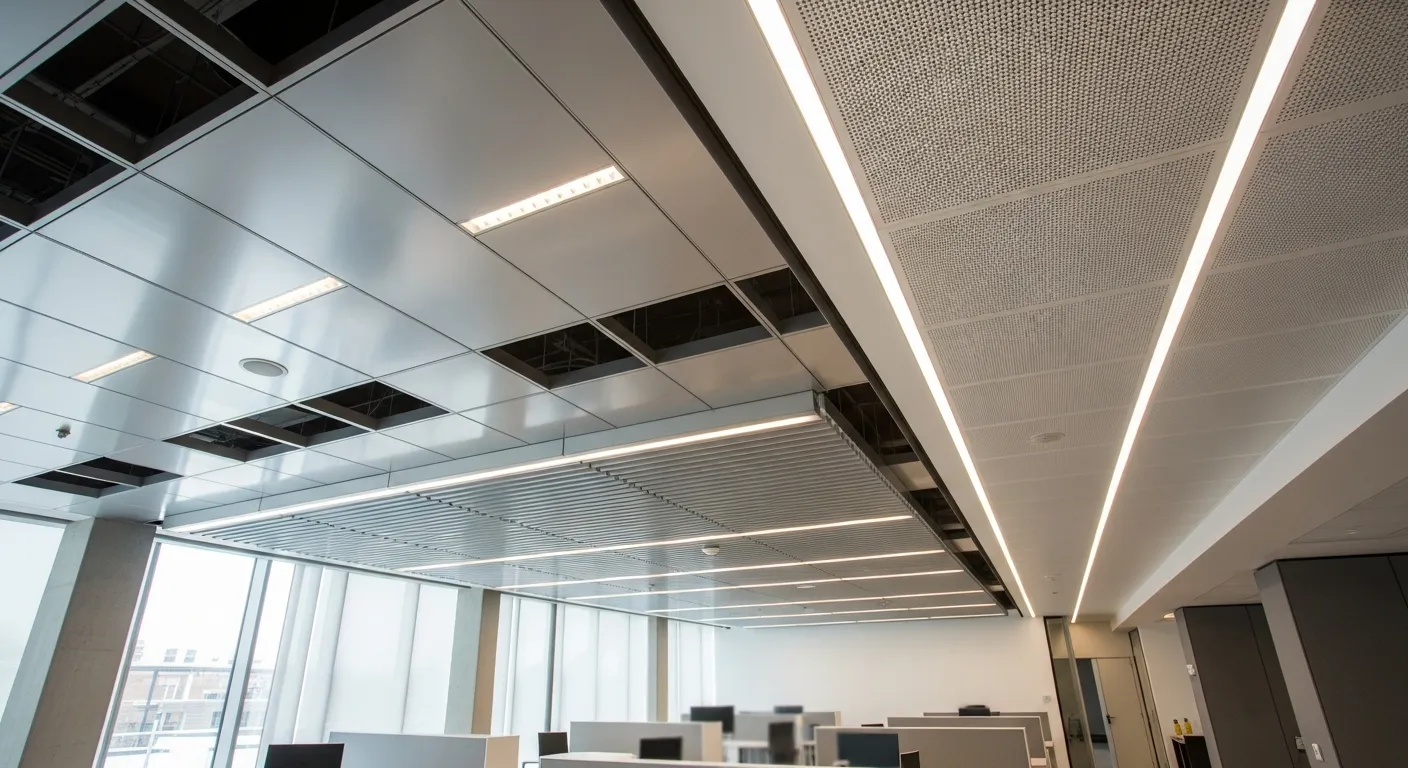
Metal ceiling systems have become a go-to choice for commercial construction, and it's not hard to see why. They hold up well under heavy use, look clean across a wide range of building types, and give architects real flexibility when working around HVAC, lighting, and fire suppression layouts.
This guide covers everything you need to make informed decisions about metal ceiling systems — from the types available and their acoustic performance to installation, maintenance, and long-term costs.
What Are Metal Ceiling Systems and Why Do Commercial Buildings Use Them
A metal ceiling system consists of three main parts: the suspension grid anchored to the structural ceiling, the panels that slot or clip into place, and any backing material added for acoustic or fire performance. The grid carries the load and sets the module size, while the panels define the finished look. Most commercial systems use aluminum or steel, with aluminum being the lighter and more corrosion-resistant option.
Perforated metal ceiling panels are one of the more popular panel choices in this category. The perforations work alongside backing fleece or mineral wool to absorb sound rather than bounce it back into the room, which makes them a practical pick for offices, lobbies, and corridors where echo is a real concern. You see, the aesthetic appeal and the acoustic function tend to come as a package deal with this type of panel.
What sets metal apart from gypsum or mineral fiber is how it holds up over time. Metal panels don't sag, discolor, or crumble when exposed to humidity, and they won't show damage the way softer ceiling materials do after a maintenance crew has been up in the plenum. A good aluminum system can last 30 to 40 years with minimal intervention, which matters when you're looking at the full cost of a commercial build.
Architects and contractors favor metal systems also because they work well in exposed or semi-exposed ceiling designs. Open-plan offices, airports, retail spaces, and healthcare facilities all deal with complex service layouts above the ceiling line. Metal systems, with their modular grids and removable panels, make it straightforward to access that space whenever needed without tearing anything apart.
Types of Metal Ceiling Systems Available
Linear or plank systems run in long parallel strips and work well in corridors, retail environments, and spaces where a directional visual effect is desirable. Tile or modular systems, on the other hand, use square or rectangular panels set into a visible or concealed grid, giving a cleaner, more uniform look across larger ceiling areas. The choice between the two usually comes down to the architectural intent and how much of the grid the designer wants to show.
Fixing methods matter more than most people expect at the specification stage. Snap-in panels drop into an exposed grid and pull out without tools, which makes future access straightforward. Lay-in systems are similar but rely on gravity rather than a mechanical clip. Concealed fixing systems hide the grid entirely behind the panel face, producing a seamless surface — though accessing the plenum above takes a bit more effort.
When it comes to materials, aluminum dominates commercial metal ceiling work. It's lighter than steel, doesn't rust, and takes paint or anodizing well. Steel panels do appear in certain applications where higher load ratings or specific fire performance are needed, and galvanized variants add an extra layer of corrosion protection in humid or coastal environments. The material you choose will affect both the finished weight of the suspension system and the long-term maintenance picture.
You see, the open-cell versus closed-cell distinction is also worth paying attention to. Open-cell systems use a visible grid structure with gaps between panels, which lets air move freely and gives the ceiling a more industrial or architectural character. Closed-cell systems cover the grid completely and produce a smooth, uninterrupted surface. Each serves a different purpose depending on the acoustic targets, the HVAC strategy, and the visual outcome the project calls for.
Acoustic Performance and Sound Control
Metal on its own is a reflective material, so an unlined metal ceiling panel will bounce sound around a room rather than absorb it. The way most systems address this is by adding a porous backing layer — typically acoustic fleece or mineral wool — directly behind the panel face. The sound passes through the perforations or slots in the panel and gets absorbed by the backing rather than reflected back into the space.
Noise Reduction Coefficient ratings tell you how much sound a ceiling assembly absorbs across a range of frequencies, with 0 meaning total reflection and 1 meaning total absorption. Most commercial metal ceiling assemblies with mineral wool backing land somewhere between 0.70 and 0.95, which is more than adequate for open offices, meeting rooms, or public lobbies. You should always check the NRC rating for the specific assembly you're specifying, not just the panel type in isolation.
Different spaces have different acoustic demands. An auditorium needs careful control of reflections and reverberation time, while a hospital corridor mainly needs to limit speech transmission between areas. Open offices deal with a constant low-level noise problem that benefits from high absorption across the mid-frequency range. Matching the ceiling system to the acoustic brief is something worth doing early in the design process, before the structural grid gets locked in.
Also, most building codes don't set hard acoustic requirements for ceilings in the way they do for fire ratings, but green building certifications like LEED and WELL do include acoustic credits. If the project is targeting any of these ratings, the ceiling system selection feeds directly into the scorecard, so it's worth looping in the acoustic consultant before the specification gets finalized.
Fire Resistance and Safety Standards
Metal ceiling assemblies are fire-rated as part of a tested system, which means the panel type, grid, plenum depth, and any backing material must match the tested configuration. You can't swap one component out and expect the rating to hold. Most commercial projects in the US reference ASTM E119 for floor and ceiling assemblies, while European projects follow EN 13501, which uses a letter-and-number classification system to describe reaction to fire and fire resistance separately.
The plenum space above a suspended ceiling complicates the fire picture somewhat. That void can act as a channel for smoke and hot gases if it's not properly compartmentalized, which is why fire-rated assemblies specify maximum plenum depths and often require rated enclosures around penetrations. Any opening in the ceiling for a light fixture, air diffuser, or sprinkler head must be carefully detailed to maintain the integrity of the assembly.
Sprinkler integration is one of the more technically involved parts of specifying a metal ceiling system for commercial use. Some systems use concealed sprinklers that sit flush with the panel face, while others require open grid configurations to allow standard pendant heads to function without obstruction. The choice affects both the visual outcome and the fire suppression strategy, so the ceiling spec and the sprinkler layout need to be coordinated from the start rather than resolved separately.
You see, local building codes sometimes layer additional requirements on top of international standards, particularly for high-occupancy buildings like hospitals, schools, or assembly spaces. Getting a fire engineer involved early helps prevent the ceiling specification from running into problems later during the building control review.
Conclusion
Metal ceiling systems provide commercial buildings with a durable, flexible, low-maintenance overhead solution that performs well across a wide range of environments and building types. From acoustic-lined perforated panels in open offices to fire-rated assemblies in high-occupancy public buildings, the right metal ceiling system comes down to matching the specification to the actual demands of the space.